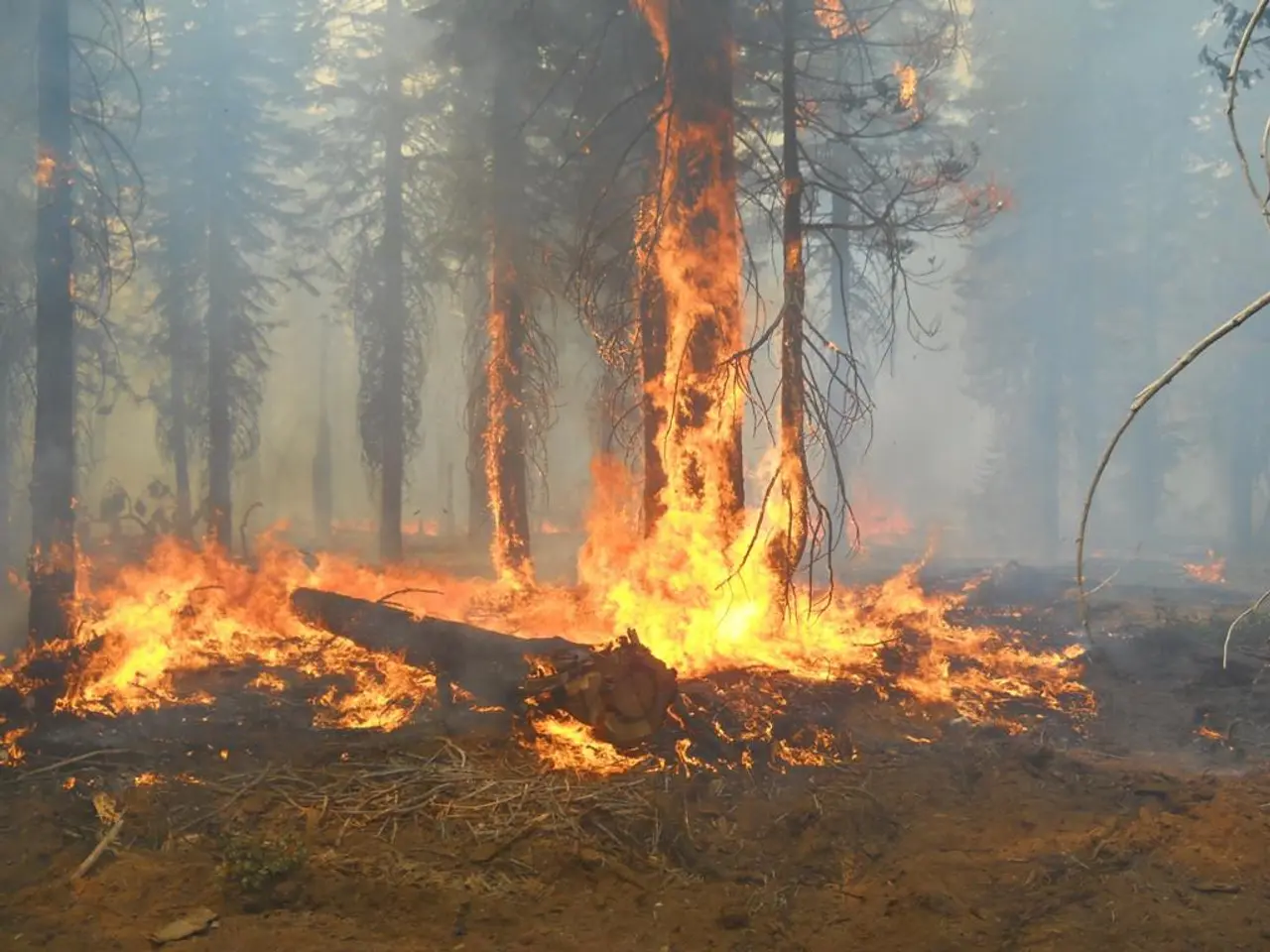
Fires are playing a significant role in speeding up the loss of global forests
Record Wildfires Ravage the Amazon Rainforest: Climate Change and Human Activities Converge
The Amazon rainforest, often referred to as the "lungs of the Earth," is facing a critical crisis as climate change and human activities have significantly increased the frequency and severity of wildfires. In 2024, this trend reached a devastating peak, with the Amazon wildfires impacting more than 6.7 million hectares in Brazil alone – a figure that more than doubled the previous record [1][2][3].
Climate change has played a significant role in this shift, intensifying droughts, heat, and the drying of the forest. This reduction in natural humidity, which normally prevents large fires, has made the Amazon rainforest more susceptible to wildfires [1][3].
Several key factors contribute to this trend. More frequent and severe droughts, caused by rising temperatures and changing rainfall patterns linked to climate change, dry out soils and vegetation, making fires more likely and intense [1][2]. Human activities such as deforestation and forest degradation, often used to clear land, are also on the rise. Some forests are now igniting even before being fully cut, creating a worrying new pattern that worsens forest loss and fire risk [3][5].
Increased heat stress, caused by warming temperatures, further weakens the forest ecosystem, making it more vulnerable to fires [1][3]. Additionally, feedback loops are created as fires and forest degradation lessen the forest's ability to retain moisture and carbon, which further exacerbates warming and drying, creating a self-reinforcing cycle [3][5].
Brazil and Bolivia accounted for two-thirds of the record tropical forest loss of 6.7 million hectares in 2024, with the Amazon wildfires accounting for the most forest loss in the region for the first time [1][2][3]. The Cerrado tropical savannah, Atlantic Forest, Pantanal wetlands, Gran Chaco tropical dry forest, and other regions were also heavily affected by wildfires in 2024 [1][2].
The data, released by the Brazilian research institute Imazon in January, shows that Brazil's Amazon degradation increased sixfold to 3.6 million hectares in 2024, the highest level since records began in 2009 [1][2]. This increase was primarily due to last year's fires. Forests that have burned become more susceptible to catching fire again due to loss of shade and the abundance of dead trees, suggesting more wildfires ahead [1][5].
Temperatures are expected to continue to increase, further escalating the threat to the Amazon rainforest. The loss of this vital ecosystem would have catastrophic consequences for global biodiversity, carbon storage, and climate regulation [1][3].
[1] Data released by Brazilian research institute Imazon in January [2] WRI [3] NASA [4] MapBiomas data series [5] The Guardian
- The surge in wildfires in the Amazon rainforest, often called the "lungs of the Earth," is influenced by climate change, which intensifies droughts and heat, drying out the forest and making it more vulnerable to fires.
- Human activities, like deforestation and forest degradation, also contribute to the increased frequency and severity of wildfires in the Amazon, as some forests are now igniting before being fully cut, creating a concerning new pattern.
- The Science of environmental-science indicates that increased heat stress, caused by warming temperatures, weakens the forest ecosystem, making it more susceptible to fires and further worsening the impact of climate change on the Amazon.
- The loss of the Amazon rainforest, due to climate change, deforestation, and wildfires, would have dire consequences for global health-and-wellness, as it is critical for biodiversity, carbon storage, and climate regulation.